
Introduction
Most famous diamonds owe their reputation to beauty, mystery, or the people who owned them. However, The Cullinan Diamond earned its place in history for a far simpler reason—it was enormous.
Discovered in South Africa in 1905, the rough stone weighed an astonishing 3,106 carats. As a result, it became the largest gem-quality diamond ever found. More than a century later, no larger diamond has been discovered. Yet the story of The Cullinan Diamond begins long before a mine manager spotted a flash of light in a quarry wall. It starts with a determined farmer, a handful of peach trees, and children finding sparkling stones in the veld east of Pretoria.
Before The Cullinan Diamond Discovery
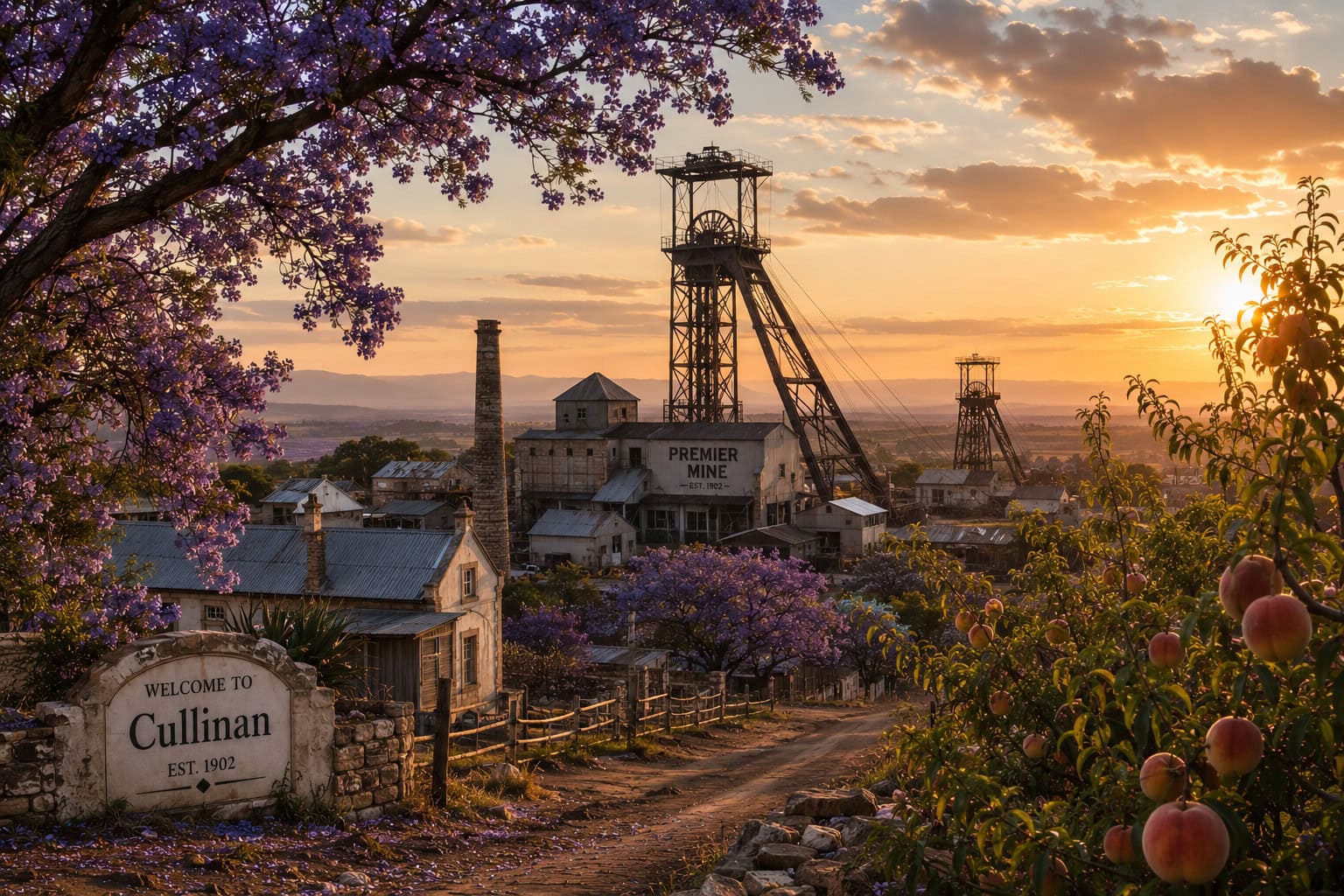
Today, the village of Cullinan lies about forty kilometers east of Pretoria. Visitors can stroll beneath jacaranda trees, admire historic buildings, and explore the old mine that made the town famous.
In the late nineteenth century, however, this was farming country. One of the area’s most memorable residents was Willem Prinsloo, a Boer farmer known as “Willem Wragtag” because of his stubborn nature.
Born in 1839, Prinsloo participated in the Great Trek from the Cape Province to the Transvaal. He spent much of his life raising cattle and hunting game. Above all, he had little patience for prospectors.
By the 1880s, gold seekers were moving through the region and offering attractive sums for farmland. Prinsloo resisted every attempt to buy his property.
The reason was surprisingly simple. He had planted peach trees.
After years of waiting, the trees had finally begun producing fruit. Therefore, he refused to sell his land only to watch miners remove them. Eventually, negotiators offered enough money for him to purchase several new farms and establish additional orchards.
One of those farms was Elandsfontein. He purchased it as grazing land for cattle. At the time, he had no idea that beneath the soil lay one of the richest diamond deposits ever discovered.
Early Clues and Rumors
Long before geologists identified a diamond pipe, local children noticed something unusual.
Streams flowing from nearby hills occasionally revealed sparkling stones. Children picked them up and carried them home. Some used them in games, while others simply kept them because they looked interesting.
To the children, they were curiosities. To prospectors, they were clues.
Eventually, small diamonds were discovered on neighboring farms. As a result, treasure hunters became convinced that a major deposit existed somewhere nearby. If diamonds were appearing in streams, they had to be coming from a source underground.
Not everyone agreed.
Experts from Kimberley, South Africa’s leading diamond center, remained skeptical. At the same time, the Witwatersrand region was becoming famous for its gold deposits.
As reports of discoveries increased, local newspapers expressed frustration over the lack of public interest. One Pretoria newspaper argued that if similar finds had occurred near Kimberley, the entire colony would have reacted with excitement.
For the moment, however, the diamond field east of Pretoria remained largely overlooked.
Thomas Cullinan and the Search for Diamonds
The man who changed everything was Thomas Major Cullinan.
Unlike many prospectors, Cullinan combined patience with determination. The Johannesburg businessman became convinced that a significant diamond deposit existed near Elandsfontein.
The challenge was convincing Willem Prinsloo to sell.
Stories about Prinsloo’s hostility toward prospectors were well known. According to local accounts, Cullinan developed an unusual plan to gather information about the geology of the area without attracting attention.
A Creative Investigation
One story claims that an ox contracted a contagious disease while on Prinsloo’s farm and needed to be buried immediately. A burial pit exposed soil layers that Cullinan believed showed evidence of diamond-bearing ground.
Whether completely true or improved through years of retelling, the story illustrates Cullinan’s persistence.
Still, Prinsloo refused to sell.
However, Cullinan did not give up. He reportedly promised his wife, Annie, that one day he would bring her the biggest diamond in the world.
On August 20, 1898, Willem Prinsloo died. Soon afterward, the Anglo-Boer War disrupted plans for development. After peace was restored, Cullinan renewed his efforts.
The Prinsloo family faced financial difficulties after the war. Consequently, they agreed to sell the property. Once Cullinan secured the land, serious exploration began.
His gamble would prove remarkably successful.
How The Cullinan Diamond Was Discovered
On January 26, 1905, Frederick Wells, surface manager of the Premier Mine, was carrying out a routine inspection.
As he examined the mine workings, a flash of light caught his attention. Embedded in the wall below the surface was what appeared to be a large crystal.
Using a pocket knife, Wells carefully removed it.
The stone was unlike anything the diamond industry had ever seen.
It measured nearly four inches long and weighed 3,106 carats. At first, some observers suspected it was merely a piece of glass.
It was not.
The crystal was a diamond of extraordinary size, clarity, and quality.

The Forgotten Contributor
One detail often overlooked is that Wells may not have been the first person to notice the stone. Historical accounts suggest that an African worker spotted the unusual crystal and brought it to Wells’s attention.
Unfortunately, his name was never recorded.
As a reward, he reportedly received a horse, saddle, and bridle. Wells received a bonus of £2,000, which was a substantial sum at the time.
News of the discovery spread rapidly around the world.
Thomas Cullinan celebrated in grand style. Contemporary accounts describe one of Johannesburg’s most lavish parties taking place at his Parktown residence.
The Premier Mine had produced the largest gem-quality diamond ever found.

From Rough Stone to Crown Jewels
Despite its fame, finding a buyer proved surprisingly difficult.
The diamond remained unsold for nearly two years. Eventually, the Transvaal Government purchased it for £150,000 and presented it to King Edward VII as a birthday gift in 1907.
The next challenge was cutting the stone.
The Famous Decoy Shipment
Transporting the diamond to Europe required careful planning.
Newspapers reported that The Cullinan Diamond would travel to Amsterdam under heavy guard. Detectives were assigned, and security arrangements received extensive publicity.
However, the publicity was part of a clever deception.
While public attention focused on the heavily guarded shipment, the real diamond was quietly carried by an Asscher family representative in his pocket across the English Channel.
At the same time, the decoy package traveled aboard a British naval vessel.
The strategy worked perfectly.
Joseph Asscher’s Historic Achievement
The cutting of the diamond was entrusted to the Asscher family of Amsterdam, whose expertise was respected worldwide.
After months of study, Joseph Asscher identified the best location for the cleaving blow.
A popular story later claimed that he fainted after successfully splitting the stone. However, historians generally consider the tale unlikely.
Contemporary evidence suggests Asscher remained calm and continued working. In reality, the achievement was impressive enough without embellishment.
The first split divided the giant crystal into two major pieces. After that, further cutting and polishing produced nine principal diamonds, ninety-six smaller brilliant-cut stones, and several fragments.
The two most famous stones became Cullinan I and Cullinan II.
Cullinan I, also known as the Great Star of Africa, weighs 530.2 carats. It remains the largest clear-cut diamond in the world.

The Legacy of The Cullinan Diamond
More than a century has passed since that flash of light appeared in the Premier Mine.
The Cullinan Diamond remains the mine’s most famous discovery. However, it was far from the only remarkable gem recovered there.
Over the decades, the mine produced several exceptional diamonds. These included the Centenary Diamond, the Niarchos Diamond, the Premier Rose, and the rough stone that became the famous Elizabeth Taylor–Richard Burton Diamond.
Few mines in history have yielded so many extraordinary gems.
Why the Story Still Matters
What makes this story memorable is not simply the size of the stone.
Instead, it is the unlikely chain of events that led to its discovery.
A farmer focused on peach trees rather than minerals. Children collecting sparkling stones from streams. Prospectors dismissed by experts. An unnamed worker whose contribution faded from the historical record. A determined entrepreneur willing to risk his fortune.
Together, they helped uncover a diamond so remarkable that it eventually became part of the British Crown Jewels.
Not bad for a farm originally purchased as grazing land.
FAQs:
The Cullinan Diamond is the largest gem-quality rough diamond ever discovered, weighing 3,106 carats.
It was discovered at the Premier Mine near Cullinan, South Africa, on January 26, 1905.
The rough stone was cut into nine principal diamonds and numerous smaller stones, including Cullinan I and Cullinan II, which are part of the British Crown Jewels.
Because of its historical significance and unique size, experts consider it effectively priceless.

Conclusion
More than 120 years after its discovery, The Cullinan Diamond continues to fascinate historians, gemologists, and visitors alike.
Its journey from a South African mine to the British Crown Jewels is one of the most remarkable stories in diamond history. In addition, the people connected to its discovery remind us that history is often shaped by unexpected events and overlooked contributors.
Experts have long suggested that the magnificent stone may have been only part of a much larger crystal. Therefore, the mystery surrounding the missing pieces continues to capture the imagination. When you see someone carefully scanning the ground, perhaps they are still hoping to find the missing fragments of The Cullinan Diamond.
References
- https://www.gia.edu/gems-gemology/summer-2006-cullinan-diamond-scarratt
- https://en.wikipedia.org/wiki/Cullinan_Diamond
- The Diamond Route by Hans Strydom
- Diamonds by Eric Bruton
You must be logged in to post a comment.